Pages

Showing posts with label Maths Problem Solving. Show all posts

Monday, 20 September 2021

Maths is all around us! Collaboration with Auroa School


Maths is EVERYWHERE! It surrounds us in nature and technology. Everyday tasks such as driving, playing sports or cooking, require us to use Maths.

Maths influences our daily lives. Galileo said, "Mathematics is the language with which God has written the universe."   


In collaboration with our friends at Auroa School in Taranaki, we asked the students to put on their "Maths Eyes" and look for Maths around them. We started adding to these slides in lockdown. 

Can you answer the questions? Can you create your own Maths questions? 


The purpose of having Maths Eyes is to show that Maths is meaningful and it is not just something that we do in school. 

'Why is it important to have Maths Eyes?
  • Having maths eyes promotes the usefulness of mathematics – Everyone has maths eyes they just need to be opened. Involves individuals, parents, children, young adolescents, pensioners, teachers, tutors.
  • Having maths eyes builds confidence in mathematics.
  • Having maths eyes encourages the use of the real world as a starting point for the relevant exploration in the maths world.
  • Having maths eyes provides excellent opportunities for linking education (primary, secondary, adult) and community.
  • Having maths eyes provides a platform for adults and children to share their maths eyes in their everyday life whether they are shopping, walking, driving, at sports events – everywhere. Open a channel for dialogue about real world mathematics.
  • Maths Eyes provides parents with opportunities to talk about mathematics that are not related to homework
  • Having maths eyes promotes active citizenship and informed decision making.
  • When teachers, and tutors have maths eyes they can identify real world starting points for mathematics teaching and learning that are relevant to the social, cultural and educational context of their learners.
  • Developing maths eyes helps to create a new inheritance for future generations –‘ we are all real world maths people’
This list was directly quoted from the Maths Eyes Website: http://www.haveyougotmathseyes.com/


Playing Maths games are fun!

Wednesday, 15 April 2020

Maths is all around us!

Ella has been posting real life problems on Seesaw. We loved this idea and thought it would be a great activity for everyone. 

Can you add your own problems to the slides? 


One of Ella's problems: Grandma came to get some eggs. She brought with her two cartons. There was one space left in the cartons when they had their eggs in them. One box had 10 spaces and one had 6 spaces. Grandma asked - how many eggs were there? If there was a whole tray how many eggs would there be?


Olive has written a story about Number Frog. Number Frog can appear in Maths, story writing and is also helping the police to solve crimes! 


Thursday, 17 August 2017

Maths Week Collaboration with our friends at Auroa Primary School

It's Maths Week!

Last Friday we wrote our own Maths problems for each other and our friends at Auroa Primary School. You can see our problems if you scroll down to Week 4 on our Online Maths Document, Term 3, 2017

Check out their Blog: Auroa Primary School/ Room 3 Blog

Some of the students at Auroa School solved some of our problems:


They wrote some problems for us: 


We have solved these problems and have put them on Seesaw. 
By Rico
By Flynn and Henry

By Elliot
By Caitlyn

Friday, 12 May 2017

Designing a Windy Wellington Theme Park


In Maths this week, we have been designing our own Theme Park. We have been collaborating, sharing ideas and coming to a consensus. We have set group goals together and have been reflecting on these goals. Please look at our presentation:

Thursday, 11 February 2016

Maths Problem Solving Strategies.

Maths Problem Solving Strategies.

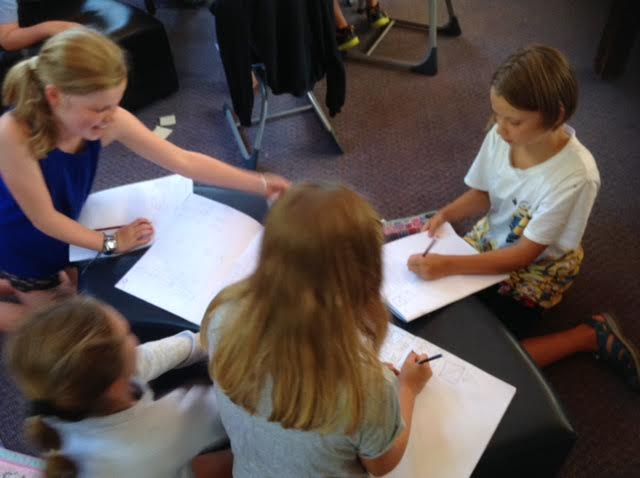
We have been getting stuck in to new learning in Maths.  Here you can see students involved in collaborative problem solving exercises.  We have been discussing and practicing different strategies for solving complex problems.  Some of the methods we have looked at already are Trial and Improvement (formerly known as Trial and Error) and Drawing a Diagram.  Some students actually made a model of one problem.
What does Problem Solving require?
  • Creative and flexible thinking
  • Discussion
  • Questioning each other
  • Exploring possibilities
  • Perseverance

Kids comments……….
What have you found out about Problem Solving?
  • It can be hard
  • You have to keep talking to each other
  • We are using Trial and Improvement and drawing a diagram and sometimes, using them both at the same time