Pages

Showing posts with label patterns. Show all posts

Tuesday, 4 December 2018

3D Cube Towers: Learning Maths with Visual Patterns


3D Cubes by Lachlan

We have been exploring a sequence with 3D cubes. We asked the the question how do you see the pattern growing? 

We drew the cubes on isometric dot paper. Some of us found this really challenging and we needed to use a Growth Mindset to work through the challenge. 

We worked hard to find how many cubes would be in the 5th tower in the sequence. We begun to explain how we could work out the number of cubes in any tower in the sequence. 
Rim: We are learning to draw 3D shapes and to work out how to count all the cubes together. I spotted my mistakes here. Mistakes help the brain to grow.  


Orla: We are drawing what we think the pattern will look like when it is bigger. We think it will look like this. We are practising drawing 3D shapes and learning about height width and length.


Some of our students were so inspired that they ran a workshop on 3D shapes with Tautoru kids.

Megan: We taught year 1s, 2s and 3s to make a cube tower. They did it really well. They persevered a lot. It felt weird to see how tricky it was for them but it was cool when they finally worked it out. It made me feel good that I could help other people and give back to the school.

Ruby: The kids were really nice and did their best! I had to use perseverance and kindness. Sometimes the kids (and sometimes me) found it challenging. It can be quite hard to explain. I had to use courage because it can be nerve wracking. I thought that they might not listen. It was fun and would love to do it again. It is good to help others to try new things.

Friday, 24 November 2017

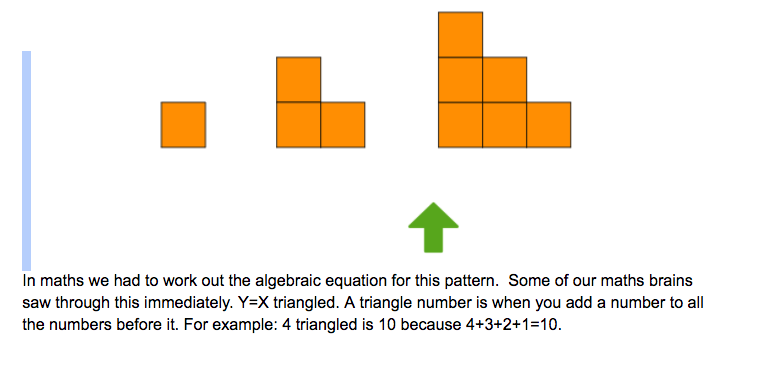
Patterns in Maths Triangle Numbers.

Patterns in Maths

We have been exploring patterns in Maths using visual prompts.  There have been some great questions to help explore the ideas.
What would be the hundredth shape in the pattern? What shape would precede the first one? How can we express the pattern in words?  What is the rule?  What is the equation which shows the pattern?  Is it a linear equation?  How can we tell?

This is an example of some of the thinking which Alexander, Rico and Jan have been doing.  Exciting stuff!


Monday, 18 January 2016

Global ibook: The World is my Audience #3 Patterns

At the end of last year we were involved in a project called, "The World is my Audience". The focus was on patterns and we chose to learn about Fibonacci numbers and patterns in nature. 


Message from organiser, Johnathon Smith: #twima3 is now live in the iBookstore.  Tell everyone you know of every platform you use.  Let's get millions of downloads of the iBook.  I am very happy with the way this book turned out and I hope you are too.  A special thanks goes out to all of you who were willing to be part of this project.  A major round of applause needs to go out to Leah LaCrosse who helped me compile this iBook for all of you.  Below you will find a link to #twima3.  Share at will and keep your eyes peeled for #twima4 which starts at the end of next month.


Monday, 19 October 2015

Fibonacci Numbers

We learnt the rule of the Fibonacci sequence. Fibonacci numbers are an interesting mathematical idea.
The Fibonacci Sequence is the series of numbers:
0, 1, 1, 2, 3, 5, 8, 13, 21, 34, ...
The next number is found by adding up the two numbers before it.
  • The 2 is found by adding the two numbers before it (1+1)
  • Similarly, the 3 is found by adding the two numbers before it (1+2),
  • And the 5 is (2+3),
  • and so on...


We did some investigations-
We had to continue the pattern and see how far we got.
We did other challenges too:


On many plants, the number of petals is a Fibonacci number and the seed distribution on sunflowers has a Fibonacci spiral effect.

The Fibonacci number pattern can also be seen elsewhere in nature:


    • with the rabbit population
    • with snail shells
    • with the bones in your fingers
    • with pine cones
    • with pineapples

We drew the patterns on a piece of squared paper.

IMG_9005.JPG


We went for a treasure hunt.


We enjoyed watching:


Monday, 14 May 2012

Escher


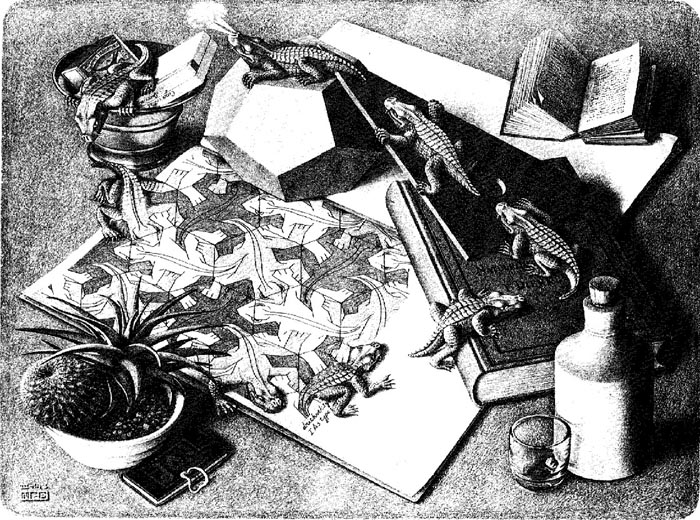
Look at this artwork by Escher. 
What do you think? 
What patterns can you see? 
Please comment…