Pages

Showing posts with label Rock Pools. Show all posts

Monday, 4 December 2017

Beach Week (s) Begins...

We began our EOTC programme today. John's base group have been sailing. We have also begun our own inquiries on the beach. We have all generated questions and have been observing and thinking like scientists. We also spent some time weeding in the dunes and giving back to our community. 

Here is the programme for the rest of the Beach Week (s): Parent Sign Up Sheet: Beach Weeks.

Please make sure that you have given permission for your child to take part in the activities. 


Here are some of the questions that we have generated: 
Where do crabs fit in with the food chain?
Do different species like different habitats?
How many crabs will be down at worser bay beach?
Where are starfish eyes?
Why do starfish crumble?
Do starfish make sound?
What types of sea life can we find in a Rock pool?
How warm can rock pools get after the sun is on them the whole day?
How much do rock pools change after an hour, 2 hours etc?
Can sea anemones be different colours?
What is the average amount of fish in rock pools?
What types of fish are in the rock pools?
Are there different types of rock pools?
What types of sea anemones are there?
What types of crabs are there?
What do the different colours on fish and sea anemones mean?
Why are snails made of slime?
Why are snails slimy?
What stage are snails on the food chain?
Why are snails slimy?
What stage are snails on the food chain?
How do snails breathe?
How many different types of snail are at worser bay beach?
How does the moon control the tide?
Why doesn’t the tide stay the same?
What is seaweed made out of?
Why is seaweed different colours?
Why is seaweed slimy?
What Is algae?
What are the most common type of algae?
Does It look like seaweed
Is algae helpful for us?
Is algae important in any way, If so why?
How is sand made?
What different rocks can make sand?
What is sand?
What different types of sand are at Worser Bay?

Monday, 21 March 2016

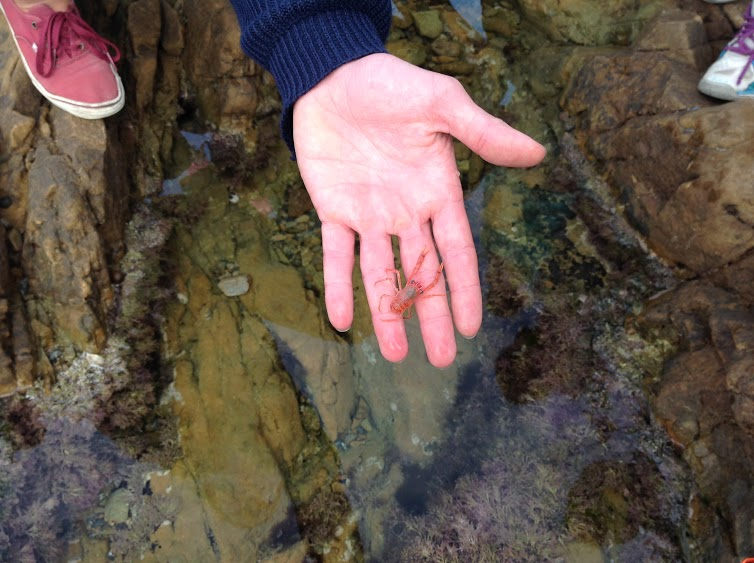
What is That Creature?

What is This Creature?
Is it some sort of Crayfish, Shrimp, Super Mutant?

Great scientists are curious about the world they live in.  Getting into the rock pools on the edge of the Island Bay Marine Reserve our students made the types of discoveries great scientists with their sharpened senses and substantial powers of observation might make.   A very aggressive creature: was it guarding its corner of the rock pool or was it hunting prey when it raised its two pronged pincers and attacked?
Can you see it in the rock pool?  It is actually staring at the photographer!

We asked Christine from the Marine Centre what it was but she said she had never before seen anything like it.  Have we discovered a new genus?  Can you help us to identify this rock pool inhabitant?

Thursday, 17 March 2016

Visiting the Island Bay Marine Education Centre and exploring Island Bay beach and rock pools

Today we were fortunate to have a great calm day to compare Island Bay beach and rock pools to the more local conditions we've already explored at Worser Bay and Breaker Bay. There was quite a big difference in what we found - many more varieties of snails and some shrimp, even a small dead octopus, but almost no         starfish at all! There were also much fewer varieties of seaweed, and no sea lettuce. We were wondering why we found different things here.


We were able to get hands on with many sea creatures we'd seen a little of already and learn more about them by touching the creatures we've been researching up close to see some of their features. Did you know starfish have five eyes at the end of their arms - they sure don't look like ours though!


We explored the beach to learn a little about the food chain on the beach especially looking at how seaweed, sandhoppers and crabs affect life in the sea. It's all connected... We also looked inside bull kelp and saw how it's internal structure has lots of air packed in a way so it can float. This allows the kelp to reach towards the light to that it can get it's energy from the process of photosynthesis, just like plants do on land.


Thanks again to those parents who were able to support our trip by joining us. We're all really excited at the thought of coming back towards the end of the year to do some snorkelling here.

Thursday, 3 March 2016

What in the world is salp?

Over the past week there has been lots of discussion about the funny looking blobs found at out local beaches. There was a lot of debate about what they could be. This led us to the conclusion that we needed to do some research. Luckily for us there was an article in the newspaper this week which we read in our reading groups. This led to more of our own research and the following reports. 


Salp
by Chester,Hayley, Blake,Caitlyn, Alex B, Sam Sh,Thomas Jackson

There has been a new sea animal that has been in Wellington beaches for the last month. People have thought it is sea lice, fish eggs, baby jellyfish and plankton. Well the the name is salp.
 
Salp can come in chains or single and can be found at Karaka Bay,Worser Bay  and Scorching Bay,Eastbourne and all the other local beaches.
Salp is completely harmless so you can still swim in Wellington  
beaches.


Salp is a filter feeder that feeds on plant plankton. Salp swim by jetting out water and is related to fish. It's also very common in Antarctica and is the most efficient in the animal kingdom. Its scientific name is Salpidae.The average size for a salp is a 2 to 7 mm blob.
image (6).png

Salp 
By Oto Betty Meg Emma R Louise Sophia Hugo M Emma M
Image result for salp
Have you spotted the small jelly like creatures at the beach?

Some people call them jelly fish and others call them sea lice. But they are really just salp and are completely harmless. Salp  are a blobby animal with a black dot in the middle. The ones in Wellington are the size of a fingernail and are a colony of animals distantly related to fish.They slowly move through the water by forming a chain then sucking in water through one end then blowing it out the other end; this is how they move and filter feed.Salp can be found all over the globe and can be as big as four inches long! You often find salp close to floating seaweed because they feed on plant planton. Salp is common around Antarctica. Salp were first discovered in 1982.