Pages

Showing posts with label algebra. Show all posts

Monday, 22 May 2023

Algebra - Visual Literacy

We have been working through Algebra Puzzles. We know that accepting challenges and sticking with a problem helps the brain to grow. We have been making our own puzzles!

We came up with a co-constructed success criteria:

Include 4 or 5 pictures
The puzzle needs a good starting point
Make the puzzle 4 or 5 lines
It needs to include some numbers
We need to remember to do the multiplication first
It needs to be simple and clear

We are producing quality work!

Bug Algebra by Kyran

Ocean Algebra by Violet

Why puzzles in Maths?

1. They develop Critical Thinking skills so that you can problem solve in different situations

2. It exercises the brain. Practising these types of puzzles helps the brain to make connections. It helps your brain get used to focusing on a single problem.

3. It will help you to be a more successful Mathematician. You will be able to apply logic to work out Maths problems successfully.

Sarah Flannery, at age of 16, won the Young Scientist of the Year award in Ireland.

This is Sarah talking about Maths and the role her parents played in her own amazing achievements.
“My parents definitely let me see that mathematics was this beautiful subject. I think a lot of people never even hear those two words in the same sentence. So they gave that to me, and they gave me, through these different puzzles, where even I thought I couldn't start out on them, they showed me, no, you have lots of tools, and techniques, and ways to visualise, and get started, and you can do it.”

Ocean Algebra by Alice

Art Supplies Algebra by Olive

Frog Algebra by Henry


Plant Algebra by Kyran

Playtime Algebra by Raife

Sky Algebra by Marcia

Locky's Football Algebra

Saturday, 11 June 2022

Can You Solve Our Algebra Puzzles?

We have been working through Algebra Puzzles. We know that accepting challenges and staying with a problem helps the brain to grow. We had an idea to make our very own puzzles!

We came up with a co-constructed success criteria: 

Include 4 or 5 pictures 
The puzzle needs a good starting point 
Include answers on the back 
Make the puzzle 4 or 5 lines 
It needs to include some numbers 
We need to remember to do the multiplication first

Animal Algebra by Violet

Why puzzles in Maths?

1. They develop Critical Thinking skills so that you can problem solve in different situations

2. It exercises the brain. Practising these types of puzzles helps the brain to make connections. It helps your brain get used to focusing on a single problem.

3. It will help you to be a more successful Mathematician. You will be able to apply logic to work out Maths problems successfully.

Sarah Flannery, at age of 16, won the Young Scientist of the Year award in Ireland.
This is Sarah talking about Maths and the role her parents played in her own amazing achievements.

“My parents definitely let me see that mathematics was this beautiful subject. I think a lot of people never even hear those two words in the same sentence.
So they gave that to me, and they gave me, through these different puzzles, where even I thought I couldn't start out on them, they showed me, no, you have lots of tools, and techniques, and ways to visualise, and get started, and you can do it.”


Pet Algebra Puzzle by Greer and Amber

Algebra by Finn H

Pikmin Algebra Puzzle by Henry

Cat Algebra by Nikita

Algebra Puzzle by Cam

Algebra by Alice and Ethan

Dragon Algebra by Tommy

Minecraft Mutant Algebra by Sam

Tuesday, 4 December 2018

3D Cube Towers: Learning Maths with Visual Patterns


3D Cubes by Lachlan

We have been exploring a sequence with 3D cubes. We asked the the question how do you see the pattern growing? 

We drew the cubes on isometric dot paper. Some of us found this really challenging and we needed to use a Growth Mindset to work through the challenge. 

We worked hard to find how many cubes would be in the 5th tower in the sequence. We begun to explain how we could work out the number of cubes in any tower in the sequence. 
Rim: We are learning to draw 3D shapes and to work out how to count all the cubes together. I spotted my mistakes here. Mistakes help the brain to grow.  


Orla: We are drawing what we think the pattern will look like when it is bigger. We think it will look like this. We are practising drawing 3D shapes and learning about height width and length.


Some of our students were so inspired that they ran a workshop on 3D shapes with Tautoru kids.

Megan: We taught year 1s, 2s and 3s to make a cube tower. They did it really well. They persevered a lot. It felt weird to see how tricky it was for them but it was cool when they finally worked it out. It made me feel good that I could help other people and give back to the school.

Ruby: The kids were really nice and did their best! I had to use perseverance and kindness. Sometimes the kids (and sometimes me) found it challenging. It can be quite hard to explain. I had to use courage because it can be nerve wracking. I thought that they might not listen. It was fun and would love to do it again. It is good to help others to try new things.

Thursday, 10 May 2018

Low Floor, High Ceiling Tasks: Algebra

Stanford Professor, Jo Boaler says that "Mathematics classrooms should be places where students work on mathematics tasks with a low entry point but a very high ceiling – so that students are constantly challenged and working at the highest and most appropriate level for them." You can read more: How students should be taught mathematics: for parents

Today some of us looked at this sequence. Students were asked "How is the pattern growing." It was interesting to see how others visualise the patterns.


We discussed what a sequence means. We came up with the definition: It is a pattern and a series of things that get bigger or smaller. We also said from the pattern you can work out what the next one will be. 

Students were Mathematical thinkers and came up with their own questions about the sequence. 

Flynn and Henry: This is a number sequence.we figured out the rest of it.

Orla and Yasmin: Today we figured out the sequence of this pattern we also figured out what the 100th 1 would be. We found out that what the added up together and other stuff like that.


Jan: I have worked out that if x = million (1,000,000) y = one trillion and one (1,000,000,000,001)
Also, this is my graph of the equation y = x squared + 1.


Maddie: Whatever number you want to times it by that number. This shows the equation for the 70,000th in the sequence.
 

Friday, 24 November 2017

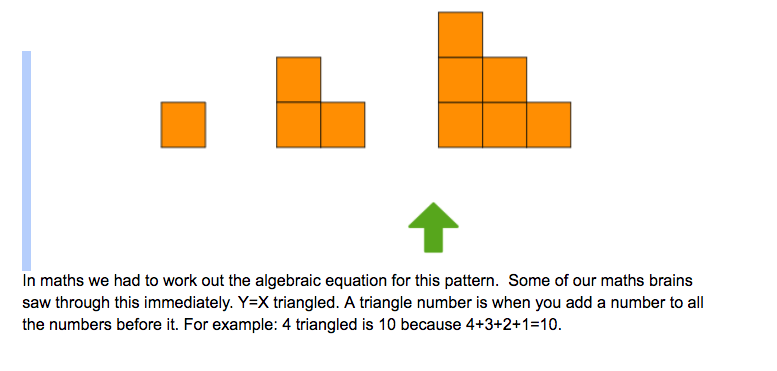
Patterns in Maths Triangle Numbers.

Patterns in Maths

We have been exploring patterns in Maths using visual prompts.  There have been some great questions to help explore the ideas.
What would be the hundredth shape in the pattern? What shape would precede the first one? How can we express the pattern in words?  What is the rule?  What is the equation which shows the pattern?  Is it a linear equation?  How can we tell?

This is an example of some of the thinking which Alexander, Rico and Jan have been doing.  Exciting stuff!


Thursday, 23 November 2017

3D Cubes


We had this problem that had 3D cubes.


First we discovered all the things that it could be. Some people thought it looked like a flower and others thought it looked like a minecraft flower. At first I thought it looked like a stamp that looked like a plus.


Then we organised our thinking into a chart. We found out that each time the pattern grew it added five. It added one to the top and one on the four sides.


Number in Sequence
Number of Cubes
1
1
2
6
3
11
4
16
5
21
6
26
7
31
8
36
9
41
10
46


We drew the next two in the sequence so we could check if it was right. We thought that we would find the tenth in the sequence. We did this by adding five.


From there we did trial and improvemnet to find a formula.


The formula is y = (y-1) 5 +1


(y is the sequence)


BEDMAS is to help us with order of oprations it help us make the formula.


By Zach