Pages

Showing posts with label sustainability. Show all posts

Tuesday, 14 December 2021

Gardening on Green Day


On the 13th of December is Green Day (Aka: Environmental day, Garden day).

On green day, everybody is encouraged to wear green and bring in seedlings such as zucchini, carrot, broccoli & lettuce.

On green day, lots of people have the opportunity to get into the school gardens and get their hands dirty. Unfortunately, because of the rain, only a few people got to get into the garden.

In the garden there was lots to be done. We had to replace all the soil in the garden boxes, pick out all the roots/ weeds that were in the soil and then plant, and finally, unreel the hose and water the new plants.

I got to help organise Green Day, be a journalist and actually get into the garden.

By Olive


Wednesday, 8 December 2021

Green Day

Meet the "Green Team"


We are organising Green Day! This will be next Tuesday (14th December)! Everybody in the school will be involved getting our gardens ready so that when we return in 2022 there will be fresh produce.

We are also making a steaming compost heap! Fun!

We would like to involve everyone in the school who is keen and will be involved in planting, weeding, watering and piling on scraps on the compost pile. 

Autahi and Tautoru will be working in their own garden spaces.

Bring compostable materials: Dry leaves, any bunny/ chicken poo, seaweed, fresh cut grass, any compostable material... 

Bring along a seedling or two: tomato plant, beans, zucchini, lettuce, herbs...

Wear your green-est outfit!

From the Green Team


Our Green Team have been collecting seaweed on the beach for composting!

Collecting leaves for composting

Friday, 20 November 2020

'Business Time!' - Market Day 2020


Promoting our wares in Tautoru prior to Market Day


Market Day 2020 was a roaring success, providing a host of wonderful learning opportunities and bringing our community out in force. Māhutonga Matariki are so grateful for the support shown to us and we invite you to watch this space as we decide how to do some good with the proceeds! 


It all began with our inquiry, 'Business Time'. We heard from our friends Bobby of Reusabowl and Andy Campbell, getting great insight into what it means to be an inventor. We learned how to go through the Design Process, from blue sky thinking to prototyping and creating. Promotional skills came to the fore as Market Day neared - posters, slogans, advertisements and jingles. In Maths we practiced dealing with money and calculating profit. Read on below for some student perspective. 


We started our Inquiry by going through the Design Process of an invention and looking at 'Thinkers Keys' to get our minds creative. We also made inventions, well when I say 'made' I mean thought of inventions to fix a big problem in the world - cats killing native birds.  When we finally started coming up with ideas for market day it was really easy, but funnelling it down to my top five was really hard. When I did finally 'funnel' them I didn’t pick what I thought would be the easiest or most fun, I picked them by what was the most sustainable and what was the most likely to get bought. All that work was actually for nothing because I ended up joining a group that already had an idea but I wasn’t that mad because it was a really fun idea - Cups (of lemonade, Cakes and Comics! 
- Hunter J

We had to identify a problem for little kids - but what? Little kids have lots of problems... they are always bored and need to learn to grow things. That's where we got the idea of Enviro Jar. When it came to getting absorbed I would give myself a 4 out of 5 as we would often lose track of time and do lots of work, then be amazed to discover it had only been half an hour. We had to think like inventors because we had to be original and also not too costly, especially because people had similar ideas and we still wanted to make a profit of some sort. This is why we partnered with another group doing something similar. I think our work was quality but that's not mine to judge, I'm just glad I did that inquiry and got such an opportunity.
- Greta L

Yesterday Market Day went really well and all of our products were sold. The cost for our product was $2.00 and our profit was $20. I bought a banana seal with a jersey, hat and a tutu/skirt, two jelly cube drinks (strawberry jelly and lemon jelly), a how to draw Homer Simpson book, a Harry Potter spell book with a wand, a cupcake and cookie, two little gardens and lots of other things!
- Aila B

We took a lot of time with our product, going through a complete Design Process, to make sure it was eco friendly. Also we thought about how it would be a reasonable price fair for us and others. Our group made exactly $51.10. We would have made around $66.10 but we needed to minus the costs. I am so proud of us, none of us were expecting so much. Next time I want a bit more time so we can make it better, but overall it was really fun, The design process, Making it & Selling it was AWESOME!
- Anastasiya SP

Saturday, 17 October 2020

Data Talks

Once a week, our Maths sessions are all about digging into data. This week we connected with some other learning around environmental sustainability and biodiversity. We examined an interesting graph which shows the levels of native or exotic species in Wellington, Kāpiti and Wairarapa. 

After a whole class discussion, we moved into our tuakana-teina learning groups to discuss. We set a collaboration goal before recording what we noticed and what we wondered. This particular graph invited us to use our knowledge of fractions and percentages, as well as reading multiple variables (land cover, population density, species richness). You can read more about Data Talks here. 


Thursday, 27 August 2020

Kawakawa Writing

For us here at WBS, cultural and environmental sustainability go hand in hand. This week we have been learning more about kawakawa - the endemic plant species well-known for its use in rongoā, traditional Māori medicine. Some students have been writing comprehensive explanations, others have been getting out into the ngahere/forest to learn how to forage and make kawakawa tea. 


                                                                                                           - Nye W

                                                                                                                         - Charlotte C


                                                                                                                                   - Ella M

We say this karakia before collecting kawakawa leaves, to show respect to the domain of Tāne Māhuta and Papatuānuku. 

You can read more about kawakawa and rongoā here. 


Friday, 27 March 2020

Working Bee

Thank you to all those who came along for some Working Bee fun!
 
We didn't know at the time that this would be our final fling until we return to 'Our Place'.  Although we will all miss the physical space, we aim to keep tightly connected.  We are all members of Te Kura ō Whetūkairangi - let's keep 'stargazing'!

Monday, 25 November 2019

Year 3 and 4 Beach Day

As part of our Positive Education programme, Year 3 and 4 spent a great day on the beach reconnecting with each other and employing some Positive Purpose. We did a clean up, a walk, play in the park and a sand castle competition. Our Learner Attribute focus this term is "Being Connected." What a great way to be connected. 


From the Institute of Positive Education at Geelong Grammar School: "Positive Purpose: The Positive Purpose domain explores understanding, believing in, and serving something greater than the self and deliberately engaging in activities for the benefit of others. It encourages students and staff to draw on their character strengths in ways that contribute to the welfare of others and the wider community. It also recognises that belonging to a supportive school community is a strong pathway to purpose and to wellbeing." 

Tuesday, 13 November 2018

Break down time

In maths we have been looking at how long different items take to break down and drawing timelines to show this. There have been some surprising results, like a computer takes 1,000,000-2,000,000 years to break down and a plastic bag 500-1,000 years.


We have also reflected on this and how we can do things differently given what we've learned. We looked at things our whanau did at the fair to have less plastic rubbish and were grateful for the steps they took to look after our environment. We did some quick writes about these.


Quick writes

Plastic
Why is plastic free peninsula a good idea? Because it is helping the environment stay clean and reduce the amount of plastic in the world that will reduce the amount in the sea. Every individual needs to change the amount of plastic they and the world are using because otherwise the world for the next generations will not survive the world with the toxic fumes and plastic which can kill you. I believe that we can help and pick u the amount of rubbish in the world we need to think as a world to put the rubbish in a safe place for everyone not just distribute the rubbish everywhere we can make that one place safe and help save the world. We need a way to clean the oceans and a safe place to put it. Singapore has a law for not littering and it is a very clean place.
WE NEED TO KEEP THE WORLD CLEAN!!!
By Orla


Why is plastic free peninsula a good idea? Plastic free peninsula is a good idea because less bird, sea animals and ect won’t die thinking that plastic is food that they can eat. Some people are doing these things that there saying that there not going to use plastic it a store or something, like new world said that next year they are not going to use plastic bags and instead you bring your own reusable bag otherwise you have to carry your food or things to the car with no bag. Lots of people are taking plastic free peninsula very serious so then they do something to help the world. Here a fact in Singapore if you litter or drop plastic and leave it on the ground you could get locked up so that’s why Singapore is very clean. These are some of the reasons why I think plastic free peninsula is a good idea.
By Eva


Because plastic is making animals sick because the are eating plastic bits which kills them because they can't get treated, but another bad thing is that we end up eating the fish that have little plastic bits which is GROSS! But on the positive side at the Worser bay school fair we didn't use plastic bags in the clothing area, instead we used paper bags and a lot of people brought their own bags. And we used paper plates, cups, bowls. And we sorted out the rubbish into bins like Plastic, recycling and paper. And in Singapore there is a law that you can't litter and you can be locked up!! Done Done Done! SO DON'T LITTER!!!
By Daisy


Quick write Plastic Why is plastic free peninsular a good idea? I think/believe that if we didn’t have plastic free peninsular we wouldn’t have as much creatures like seagulls, fish and whales there are over 3 massive islands that are filled with plastic all together it is about the same size as Australia and 50 years ago all that wasn’t there. In Singapore your not allowed to litter and if you do you you will get locked up.
By Maddie

Friday, 1 December 2017

Minecraft Eco-House Competition Winner... Alex G!

Some of our students entered a Minecraft Competition run by Interface. All of our entries were awesome and thank you to the ICT student council for organising this at Worser Bay School. 

And the winner of the Primary (Year 1-6) is... Alex G!  

See: Minecraft Marvels on Interface


This is a movie of the winning Eco House: 


My house is a hay bail house and it's also a small house.
This is my house I have solar panels, wheat farm, windmill, clay floors and a vege garden.
It is a hay bail house because it insulates my house the hay has come from ground.
I have designed this house so the windows are facing the sun meaning I dont need my lights on all the time and the house stays warm. (solar gain)
I have clay floors because it is a natural material and if there was a sunny day and a cold night it would make the house warmer because it sucks in the heat and then it pushes the heat into the house.
The rain comes off the roof and then it gets caught and then it gets used for water in the house.
The house is orientated towards the sun and it uses the energy to heat the house.
My solar panels are on the roof and they use the energy of the sun to charge the panels and this gives me power to use my lights and to heat my water.
I also have a fire to heat my home and to also help heat my water and use sticks and wood from my tree plantation.
My wheat and vege garden help produce food to eat and to feed to my animals so I can get more of them.
My windmill will also generate power for my house.
I have used timber on my house from my tree plantation.
I have a stone wall that will keep the heat in.  
I have glass walls so that the heat from the sun comes in to heat the house.

Thursday, 26 October 2017

WCC Nursery Visit.


Screen Shot 2017-10-26 at 2.32.24 PM.png
A beautiful bunch of Nikau.

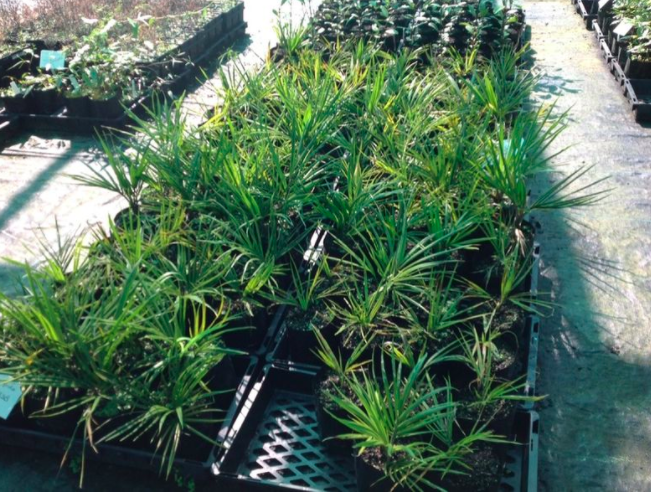
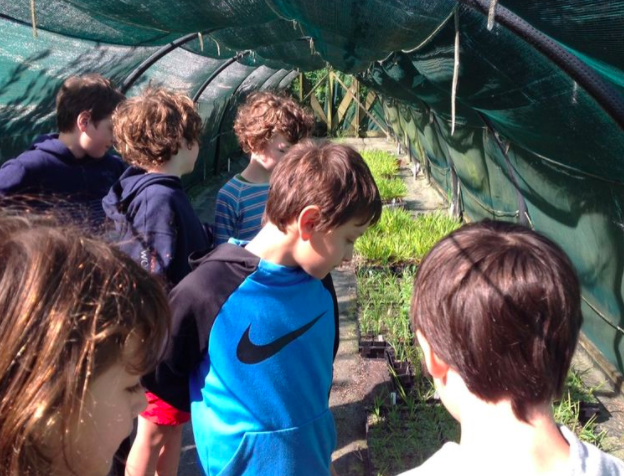
Today we went to the Wellington City Council nursery of plants.
We went to the plant nursery and we learn’t lots about plants and how to take care of plants, shrubs and other things.

We learned that our ancestors turned most of the hills into sheep paddocks by chopping trees and clearing the land. Houses are there now and WEEDS.  The council wants to turn it back to a native environment by planting the native trees that used to be there.  These include Kowhai, flax, Nikau, Totara, Miro and about 150 other species.
Also a lot of modern nurseries are very big and have robots running the operation. The city council one is smaller and people do all the work. There are still thousands of plants and most of them are natives.

Dave the nursery manager showed us around.  We looked in all the shade houses, from the smallest, newly germinated plants to the ones which are a few years old almost ready for planting out.
Screen Shot 2017-10-26 at 2.32.35 PM.png
  Fun facts about plants  
  •  When you grow kowhai in a plastic bag it will spiral up the plastic bag like a staircase.
  • They are inventing new ways to pot plants so that they don’t use plastic.  One of the new methods is made from a composite of pine bark.  
  • Some pots are designed to encourage root growth throughout the pot. These pots encourage root growth and are recyclable because they open out.           


To be Leaders in the Shade House We will need to:
  • Think about what plants we want to grow, endemic species not weeds
  • Look after the plants that are growing
  • Tell other kids about what is happening in the Shade House and show them how to respect the plants
  • Teach other kids to be leaders especially some of the year 3 kids
  • Organising a supply of seed raising mix and gravel.  How do we fund this?

What we Need to do in our Shade House.
  • Learn about the species we need to grow
  • Find seeds and people who can help us collect them, maybe Joakim.  (Seed collection permit?)
  • Investigate how much water is needed
  • Get a supply of seed raising mix and fine gravel
  • You need to know what the plants feel like and you need to know if they need to be in light, shade or something inbetween.


We finished off our tour by planting some flax seeds.  

We thought it was very good place for plants to grow and it was very fun and we learnt a lot. We are very lucky to be able to go to that place and we also thank  John .  “Thank you John”


Tuesday, 24 October 2017

Sustainable Coastlines


Today Oliver and Megan from Sustainable Coastline charity visited us to talk about what is happening with all the plastic rubbish that ends up in the ocean. It is harming the sea birds, the sea creatures and the environment. We all agreed to spread the word about plastics and to try to stop using single use plastic so that we can enjoy the beach, and so can all the creatures who live there.

After the talk, our Year 5 students did a beach clean up!